Downloads

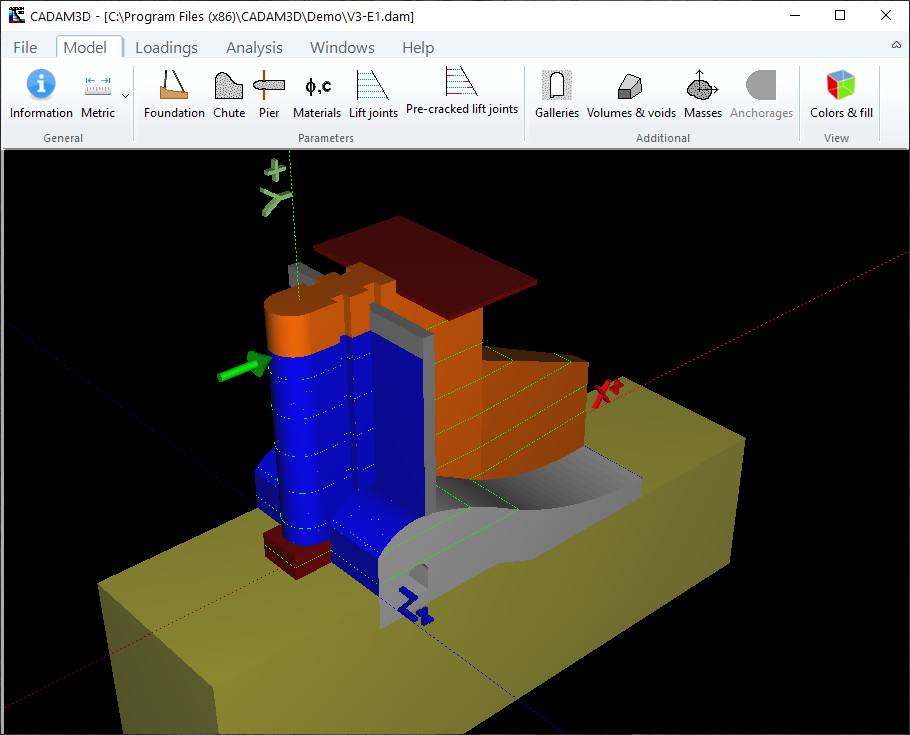
CADAM3D is a user-friendly software based on the gravity method originally developed for one of the world biggest concrete dam owner, Hydro-Quebec, and for Dams and Hydrology of the Quebec Ministry of Environment (Quebec's legislator for dam safety). CADAM3D is fully functional and is intensively used by Hydro-Quebec since 2005. To our knowledge, no other software similar to CADAM3D is available at this time.
If you perform stability analyzes of concrete hydraulic structures, this software will allow you to perform them much faster and more efficiently. If you are interested in this type of software and would like to try CADAM3D for free, please click on the button "Contact us for a free trial of CADAM3D" to send us a message.
In the ever-evolving world of contemporary Japanese art, few names command as much quiet reverence as Shiori Suwano. Known for her ethereal use of washi paper and metallic leafing, Suwano has spent two decades building a bridge between ancient Nihonga techniques and postmodern emotional landscapes. However, in the late summer of 2024, the art world was set ablaze by an event that collectors are already calling "the benchmark of the decade": Gallery Shiori Suwano 17 Exclusive .
This is not merely an exhibition or a simple art drop. The "17 Exclusive" is a meticulously curated collection of only seventeen original works, released under strict viewing conditions at Suwano’s flagship gallery in the Kyobashi district of Tokyo. For those who missed the announcement, or for serious collectors looking to understand the provenance and hype, this article breaks down everything you need to know about the Gallery Shiori Suwano 17 Exclusive. First, let’s deconstruct the keyword. The phrase refers to a limited-edition curation event hosted by Gallery Shiori Suwano (the artist’s official representative space) featuring exactly 17 exclusive pieces that will not be reproduced or shown in any other venue globally. gallery shiori suwano 17 exclusive
For the 99% of us who will never own No. 7 or No. 17, the legacy of this exclusive gallery event is clear: It resets the standard for how Japanese contemporary art is consumed. Exclusivity, when paired with uncompromising quality, elevates the entire genre. In the ever-evolving world of contemporary Japanese art,
Unlike typical gallery rotations that feature 30 to 50 works, the "17 Exclusive" was designed as an intimate journey. The number "17" is not arbitrary. In an interview released alongside the collection, Suwano revealed that 17 represents the traditional Japanese junishi cycle plus the five classical elements ( godai ), creating a numerical philosophy of completeness. This is not merely an exhibition or a simple art drop
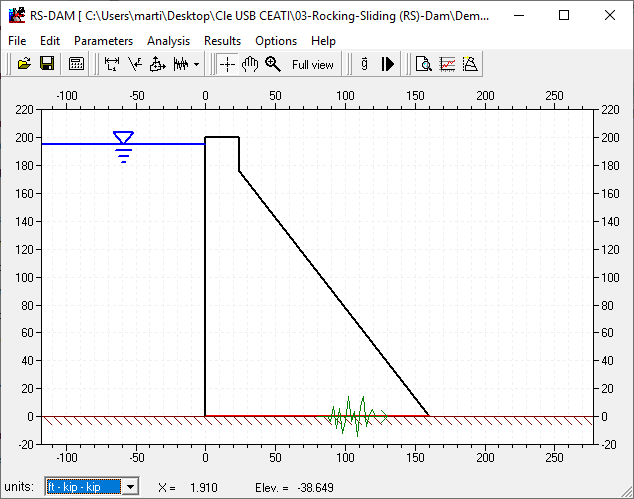
RS-DAM is a computer program that was primarily designed to provide a computational tool to evaluate the transient response of a completely cracked concrete dam section subjected to seismic loads. RS-DAM is also used to support research and development on structural behavior and safety of concrete dams.
RS-DAM is based on rigid body dynamic equilibrium. It performs a transient rocking and/or sliding analysis of a cracked dam section subjected to either base accelerations or time varying forces. Several modelling options have been included to allow users to explore the influence of parameters (e.g. geometry, additional masses, variation of the uplift force upon rotation, hydrodynamic pressures in translation (Westergaard) and rotation, center of rotation moving with sliding, coefficient of restitution of impact, etc...). RS-DAM is developed in a university context and has no commercial aspect.
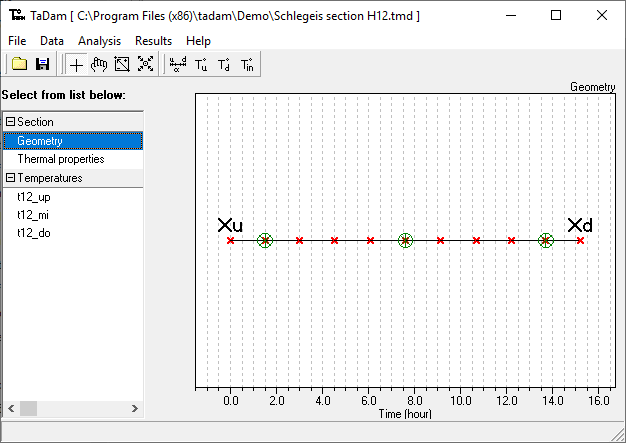
TADAM (Thermal Analysis of concrete DAMs) software employs a new frequency-domain solution technique to solve the 1D thermal transfer problem, allowing the calculation of temperature histories in a concrete dam section.
The direct solution calculates the evolution of the temperature distributions from the temperature histories of the upstream and downstream faces. The inverse solution uses temperature histories, measured inside the section, in order to calculate the temperature fields at the external faces, while taking into account the thermal wave attenuation effects and the phase angles along the section.
TADAM is developed in a university context and has no commercial aspect.